From Hype to Reality
The first wave of AI in DAM was, to put it charitably, enthusiastic. Vendors rushed to add AI-powered capabilities: auto-tagging, object recognition, background removal, on-brand image generation. The feature lists grew long and the demos were impressive.
Reality pushed back.
Auto-tagging turned out to be inconsistent. Models trained on general-purpose datasets rarely understood brand-specific context. What people expected was a system that truly understood image content and could assign assets to existing product catalogue nodes with the correct, context-aware metadata tags. What they got was a list of generic tags that needed cleaning up. Tools built to check for “on-brand” compliance often passed images that were technically correct but culturally off. They could verify a logo placement or usage of brand colors, but could not tell you whether an image was appropriate for a specific market. And AI-generated images raised immediate concerns around authenticity and copyright that nobody had a governance framework ready to handle.
Content provenance and authenticity became a concern. Standards like C2PA (c2pa.org) exist to track the origin and modification history of generated content, but they only work if supported by both the content creators and the content consumers. DAM plays an important role here, and hopefully will play an even more important role here in the future, but that is a topic for another article.
That said, AI does deliver genuine value in a DAM context today. Computer vision tasks, such as smart cropping, object detection, background removal, on-the-fly image transformation, etc. work well and save meaningful time. Natural language processing for transcription and translation is solid, auto-generated text descriptions have matured considerably and are, in practice, far more useful than keyword tags alone. These have already been adopted by many DAM vendors and provide great benefit for the user base.
The broader organisational challenge has been equally difficult. Organisations have been exposed to a wave of experimental AI features layered onto existing DAM platforms, often raising expectations that could not be met. A constant stream of seemingly “game-changing” updates from companies like Anthropic, OpenAI, and Google creates pressure from leadership to “have AI” in place, which often leads to rushed decisions and frustration when implementations fall short. Now the pendulum is swinging the other way, with many organisations becoming hesitant to adopt AI at all. (medium.com:Why Some Companies Are Hesitant to Use AI: Challenges, Considerations, and the Bigger Picture)
The right approach lies somewhere in between. Successful DAM strategies have always started with understanding the actual requirements first. If a tool helps solve a clearly defined problem and it happens to be using AI functionality, great. If not, it is just another tool, not a requirement. AI is no different.
Agentic AI: A New Kind of Requirement
The more consequential shift is the arrival of agentic AI. Very briefly speaking, the core idea of agentic AI are autonomous software processes that reason and act across systems without human input at each step. But how does this relate to DAM platforms?
The moment this became concrete for me was reading about agentic e-commerce. The idea is this: in your AI tool of choice, say ChatGPT or Claude, you type: “Buy Nike Air Force One Sneakers in white, size US 11, and make sure I get them delivered to my home address by Friday. Costs must be lower than €100 including delivery.” Your AI tool spawns an agent that searches online shops, compares offerings, evaluates authenticity, and completes the transaction. The box arrives on Friday. €89 is booked to your card.
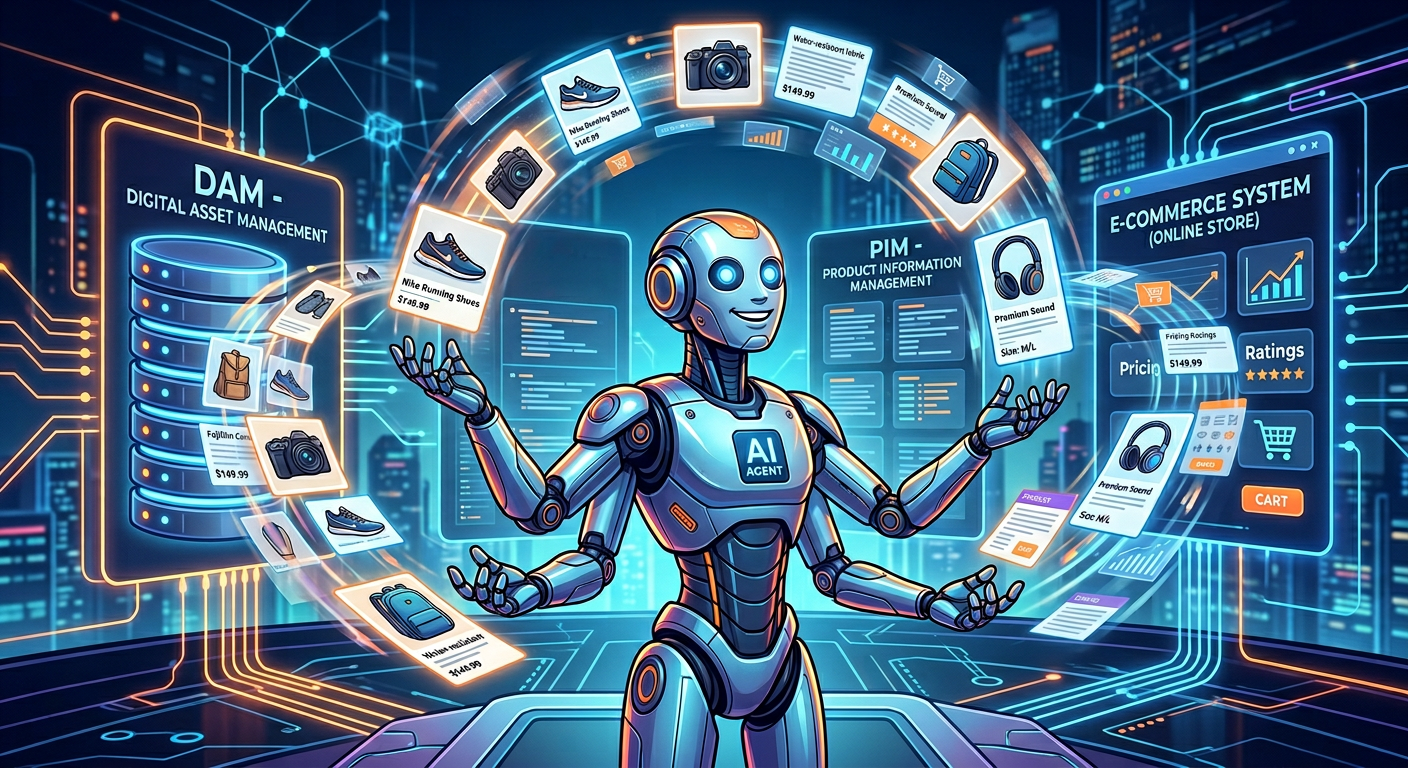
Think about what that means for DAM. In a product data-driven e-commerce environment, PIM systems provide structured product data and DAMs delivers dynamically generated, formatted assets with matching metadata: SKU, approval status, channel availability, colour, size and so on. When an agent compares product offerings, it does not care about the design of a webshop or the mood of a campaign image. It is a machine, and it evaluates products in a straightforward sequence: discover, compare, decide, transact.
The interesting part for us is the comparison and decision stages. The agent cross-references technical product data against asset metadata across several dimensions.Visual descriptors (what is depicted, from which angle, in which context), rights and approval data (approved channels, markets, usage restrictions, expiration dates), and localisation (language, market, channel alignment). It also reads Alt-text, embedded XMP/EXIF data, C2PA provenance signals, and checks how well asset descriptions match product descriptions. From all of this, it builds a confidence score. If the data does not add up, the product is flagged as potentially inauthentic and dropped from consideration.
This reframes what the DAM is for. In an agentic world, it becomes a trust layer. The system that ensures only rights-cleared, brand-compliant, and properly attributed assets enter the automation stream. For this to work, data quality is not a housekeeping concern. It is a brand and commercial imperative. Three things follow from this:
What agents see when they look at your brand. For an agent, your brand is not your logo or your campaign imagery. It is the completeness and accuracy of your structured product data.
The first touchpoint is no longer a page — it is an endpoint. Agents do not visit your website. They talk to an API. They discover, compare, and buy with every decision based on data alone.
The DAM as a competitive asset, not a filing system. Investing in metadata quality today is not a housekeeping task. It is a competitive decision.
Most DAMs can store the data required. The question is whether organisations have actually maintained it and whether it is readable by agents.
MCP: A Smarter Way to Connect Your MarTech Stack
So how do you make a DAM accessible to AI agents and why does the same answer also solve a much older integration problem?
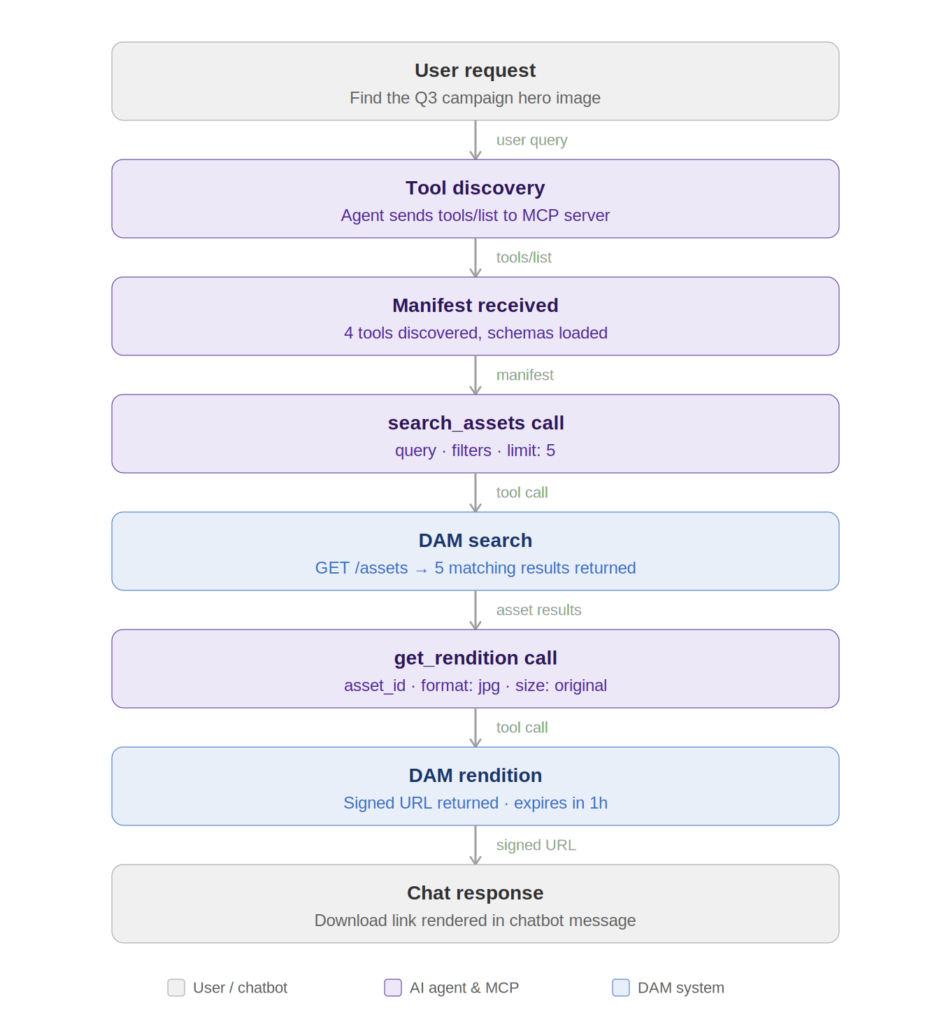
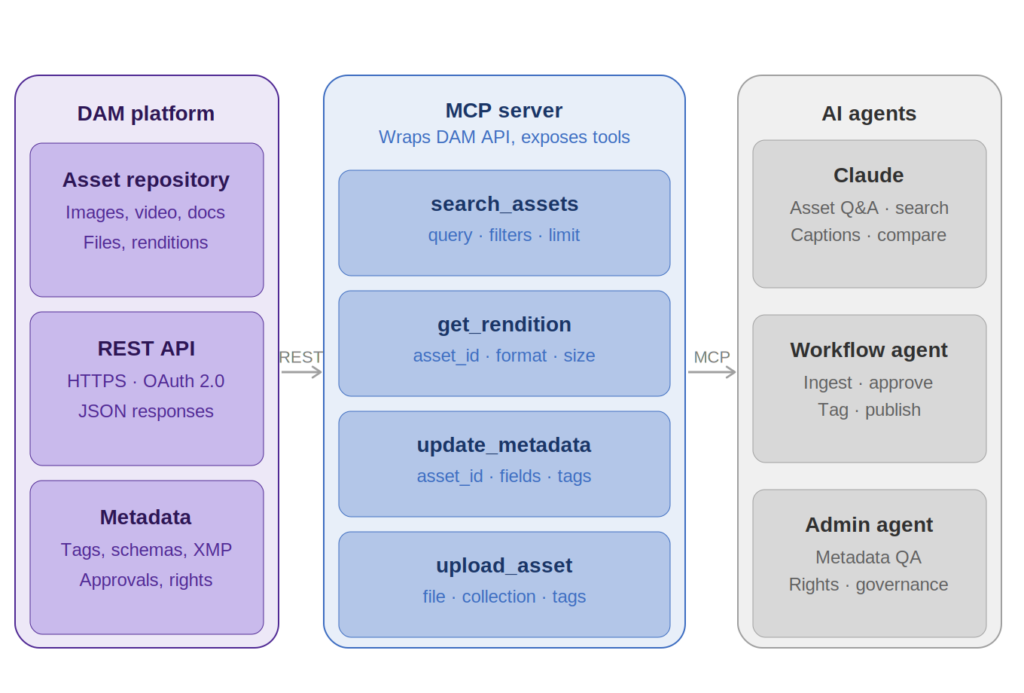
The answer is MCP, the Model Context Protocol, an open standard developed by Anthropic. MCP gives any system a standardised way to describe what it can do, so that AI agents can discover and call those capabilities without custom code. In its simplest form, a DAM vendor wraps their existing API in an MCP layer, exposing its endpoints to AI agents and making the system immediately connectable to any other MCP-compatible tool in the stack.
Once that layer is in place, you can access and manage your DAM through a prompt in an external AI tool. You could ask ChatGPT:
“Get me download links for all approved assets from the Summer Campaign 2026, convert them to an Instagram-optimised format, and send the links to my email.” This already works. I have seen live demos from several vendors.
MCP and the GUI: A Question Worth Asking
This raises something I find genuinely interesting and am not ready to answer definitively: is a text prompt actually a better interface than a GUI?
The things you can do once your DAM is agent-accessible are impressive, no doubt. But a well-built DAM GUI with faceted search is also genuinely efficient. When you open a filter panel, you see the metadata values that actually exist in your library. You do not need to remember whether the campaign was filed under “Summer_26_EMEA” or “SS26 Campaign”, you see the options and click. A text prompt shifts that cognitive load back to the user and introduces the kind of ambiguity that a well-designed UI eliminates.
For a regular DAM user who knows what they are looking for, a well-designed GUI is still hard to beat. For batch processing and automated workflows, the agentic approach has clear advantages. It is possible that AI chat interfaces will eventually become the primary way humans interact with software, in which case, accessible DAM data through a prompt will simply be a baseline expectation.
For now, the two interfaces solve different problems, and the right answer for most organisations is a DAM that offers both.
MCP Delivers Much More Than Prompted Asset Searches
Beyond the human interface question, MCP has a more significant implication: it fundamentally changes how systems integrate with each other.
DAM integration has always been painful. Every connection to a PIM, a CMS, or a project management platform has historically been a bespoke engineering project . Someone has to understand two different APIs, write glue code, and maintain it every time either platform changes. Most organisations end up with a short list of integrations that justified the cost, and a much longer list that did not.
Automation middleware tools improved this picture. You could connect systems visually, without writing code. But these tools work through point-to-point connectors, one for each pair of applications. The logic is linear and static: if X happens in system A, do Y in system B. It does not adapt, it does not reason, and when a platform updates its API, the connector may break.
MCP is a step change beyond this. Instead of bilateral connections between specific application pairs, every platform publishes a single MCP server, a standardised description of its capabilities. Any MCP-compatible system can read that and immediately know what the platform can do and how to call it. A DAM, a PIM, a CMS, and a project tool, each with their own MCP server, become composable without a single point-to-point connector between them. An agent connects to all four, understands what each can do, and orchestrates across them dynamically. New tools added to the stack are immediately available to every connected agent. The biggest benefit, in my view, is the speed with which these integrations can be deployed. You still need architectural understanding and a clear user perspective, but you can get quite far without dedicated engineering resources.
In practice, an agent can pull approved assets from the DAM, attach them to the relevant product records in the PIM, export the data to the e-commerce platform, and update task status in a project tool, all in a single scheduled sequence, without human involvement at each handoff.
I have seen live demos of exactly this type of integrations, and it is impressive. I think it will prove to be a genuine, well ‘game-changer’. But the caveats are real.
Running tasks through AI models is costly over time and consumes significant natural resources — AI data centres are projected to use ten times the electricity in 2030 compared to 2023. (Source: Energy and AI report, www.iea.org) And not all MCP implementations are equal. A vendor exposing a handful of read-only endpoints as MCP tools may be enough for a demo, but it is not enough for production agentic workflows. It is worth asking whether the vendor has implemented guardrails and intelligence around their MCP tools, rather than simply routing agent requests directly to the internal API. And let us be honest…we do not yet know if any of this works reliably at scale.
What This Means for Your DAM Strategy in 2026
On AI features — stay focused on real user needs. If a tool does not solve a clearly defined problem, it should not be implemented. Successful DAM strategies have always started with understanding the requirements first — it is no different with AI-powered tools. If it helps solve a problem, great. If not, it is just another tool, not a requirement.
On agentic readiness — ask your DAM vendor directly about their MCP roadmap. If you manage product assets for e-commerce, this is quite urgent. The agents driving the next generation of product discovery will need clean, structured, machine-readable metadata. Your DAM is either ready to serve them or it is not.
On integrations — even outside agentic commerce, MCP simplifies MarTech integration in ways worth taking seriously now. Treat MCP support as a selection criterion, not a future consideration.
On the GUI — you do not have to choose. A strong UI for daily users and an MCP layer for automated workflows are complementary, not competing.
Conclusion
AI in DAM has grown up. The experimental phase is behind us. What we are navigating now is a shift from AI as a feature to AI as part of the fundamental infrastructure through which assets are managed, governed, and accessed.
Agentic AI is the sharpest edge of that shift, as it is driven by e-commerce automation, workflow orchestration, and the straightforward fact that software agents are increasingly the systems requesting your assets. Making your DAM connectable, structured, and metadata-complete is no longer just good practice. It is a competitive requirement.
MCP will be central to how this plays out. Not because a prompt field will replace a DAM interface, but because it may become the standard channel through which agents, integrations, and automated workflows interact with your asset library.
The organisations that get ahead of this are the ones with clean metadata, well-governed libraries, and DAM vendors who have already done the work. Now is a good time to find out which camp you are in.
Frequently Asked Questions
What does agentic AI mean for Digital Asset Management?
Agentic AI refers to autonomous software processes that act across systems without human input at each step. For Digital Asset Management, this means AI agents, not just human users , are increasingly browsing the systems requesting assets and metadata. A DAM must be structured, machine-readable, and API-accessible to serve them.
What is MCP and why does it matter for DAM?
MCP, or Model Context Protocol, is an open standard developed by Anthropic that gives any system a standardised way to describe its capabilities so that AI agents can discover and call them without custom code. For DAM platforms, an MCP layer exposes existing API endpoints to AI agents and makes the system immediately connectable to any other MCP-compatible tool in the MarTech stack — including PIM, CMS, and project management platforms. DAM vendors who have implemented MCP are already demonstrating live workflows where agents retrieve, convert, and distribute approved assets entirely without human involvement at each handoff.
How does agentic e-commerce affect DAM and product asset metadata?
In agentic e-commerce, an AI agent autonomously discovers products, compares offerings, and completes transactions — without a human browsing a website. When the agent evaluates products, it cross-references structured product data against asset metadata, including visual descriptors, approval status, rights expiration, channel availability, and localisation fields. Assets that carry incomplete or unstructured metadata are flagged as potentially inauthentic and dropped from consideration. For brands managing product assets in a DAM, this means sloppy metadata no longer just creates internal inefficiency — it costs sales.
What should organisations ask their DAM vendor about MCP readiness?
Ask whether the vendor has implemented a full MCP layer or is simply exposing a small set of read-only endpoints for demo purposes. A production-ready MCP implementation should support metadata search, asset retrieval in specified formats, approval status checks, field value updates, and campaign-level filtering — not just basic asset downloads. It should also include guardrails and logic around how incoming agent requests are handled, rather than forwarding them directly to the internal API. For organisations managing product assets for e-commerce, MCP readiness should be treated as a DAM selection criterion today, not a future consideration.

Timo Faber
Timo Faber is an independent Digital Asset Management consultant and founder of dampioneers, based in Munich. With over two decades in the DAM industry, including as Product Manager at Xinet, a leading DAM vendor later acquired by Northplains, he helps organisations across the DACH region, Europe and the US select, implement, integrate and optimise DAM systems. Fully vendor-agnostic.